Have you ever looked at your life and quietly thought, “Is this it?”
It can be an uncomfortable question, partly because feeling trapped does not always look dramatic from the outside. Sometimes it looks like a life that is broadly okay. You are working, meeting responsibilities, looking after people, getting through the week and doing what needs to be done. Yet somewhere underneath it all is a sense that life has become repetitive, narrow or strangely disconnected from the person you hoped to be.
You may feel as though you are facing the same problems, the same worries and the same choices over and over again. You try a few doors, they do not seem to open, and eventually you stop checking whether any of them are unlocked. Not because you are lazy or lacking ambition, but because disappointment can be tiring. When you have tried something before and it has not worked, it becomes understandable to protect yourself from hoping too much next time.
Sometimes we really are constrained by circumstances. Money, health, caring responsibilities, relationship difficulties, work pressures, loss and uncertainty are not things that can be fixed by simply “thinking differently”. Real walls exist, and pretending otherwise can make people feel more alone. Not everyone has the same choices, resources, support or room for manoeuvre.
The Stories We Tell Ourselves
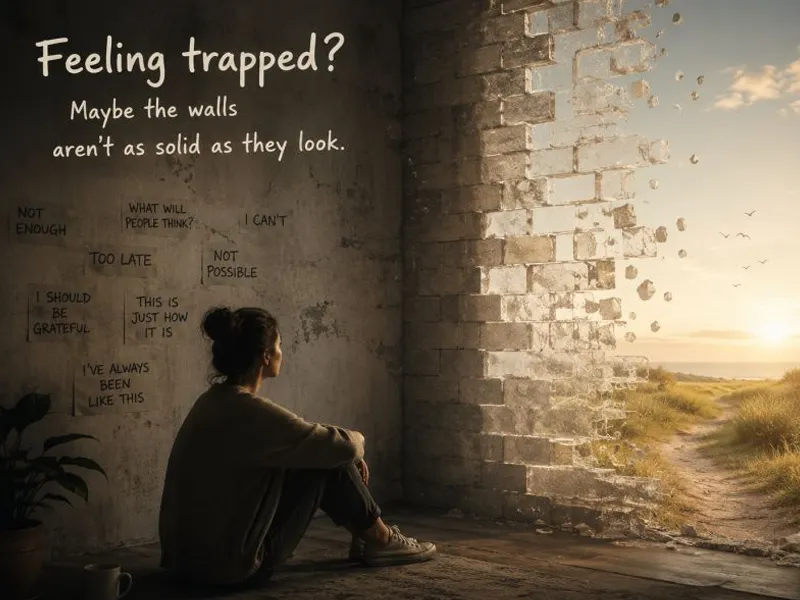
But there is often another layer to feeling trapped. Alongside the reality of a situation, we can begin to build a story about what that situation means.
“This is just who I am.”
“Nothing ever changes.”
“People like me do not get different outcomes.”
“It is too late.”
“I have tried before, so there is no point trying again.”
These thoughts can feel like facts because they are repeated when we are tired, disappointed or fearful. Over time, the mind can become so used to the story that it stops questioning it. It redecorates the prison cell, puts up some curtains and starts calling it home. Thanks brain. Very stylish. Not always helpful.
What Is Learned Helplessness?
Psychology has long been interested in what happens when people feel that their actions make little difference. One important concept is known as learned helplessness. Early research found that when individuals repeatedly experience situations that feel uncontrollable, they can become less likely to act even when opportunities for change later appear. The wider lesson is not that people are helpless, or that every difficult situation is “all in the mind”. It is that repeated setbacks can shape what we expect from the future.
When we stop believing that action can make a difference, we can stop looking for actions that might help.
This can happen in ordinary life. Someone applies for several jobs and hears nothing back, so they stop applying. Someone tries to improve a relationship, feels unheard, and decides there is no point speaking honestly again. Someone repeatedly struggles to maintain a health routine and concludes that they are simply incapable of change. The original disappointment may be real, but the mind starts to turn it into a permanent prediction.
“I failed” becomes “I always fail.”
“This did not work” becomes “Nothing will work.”
“I feel stuck” becomes “I am stuck.”
Those are very different statements. One describes an experience. The other predicts a life.
That is why feeling trapped can become so powerful. It is not only about what is happening around us. It is also about what we believe we can influence. Psychologist Albert Bandura described this as self efficacy, which is our belief that we can organise and carry out actions that make a difference. Put simply, it is the sense that while we cannot control everything, we may still be able to do something useful.
Self efficacy is not blind confidence. It is not standing at the bottom of a mountain and announcing that you are now a climber because you watched a motivational video over breakfast. It develops through experience. We begin to feel more capable when we take action and see evidence that something can shift, even slightly.
That might be a difficult conversation that goes better than expected. It might be making one phone call about a problem you have avoided for months. It might be applying for a role, asking for support, taking a walk when you did not feel like moving, or putting one small boundary in place. These actions may not transform everything, but they provide new information. They remind us that we are not entirely powerless.
This matters because confidence does not always come before action. We often wait to feel clearer, more motivated, more certain or more courageous before taking a step. But in many cases, action comes first. The feeling of capability develops afterwards.
You do not need to believe completely in a new future before you begin moving towards it. You may only need enough willingness to test one possibility.
Behavioural Activation and Breaking the Cycle
This thinking sits behind behavioural activation, a well established approach used in the treatment of depression. Behavioural activation is based on a simple but important idea. When life becomes difficult, people often withdraw from the things that give them energy, connection, meaning or a sense of achievement. That withdrawal is understandable, but it can also shrink life further. We see fewer people, do less of what matters, stop trying new things and gradually become more disconnected from ourselves.
The answer is not to force yourself to be happy or pretend that hard things are easy. It is to gently reconnect with activities that matter, even when motivation is low. Not because one walk, one conversation or one application will magically fix everything, but because action can create momentum. It can produce new evidence. It can remind us that life is still moving, even when we do not yet know exactly where it is heading.
Ask Better Questions, Not Bigger Ones
Sometimes, when we feel stuck, the most useful question is not, “How do I completely change my life?”
That question can feel so big that it shuts us down before we begin.
A more useful question may be, “What is one small thing I could do that would give me more information?”
Instead of saying, “I hate my job and there is no alternative,” you might ask, “What would I learn if I spoke to three people doing work that interests me?”
Instead of saying, “Nobody would understand,” you might ask, “What might happen if I told one trusted person that I have been struggling?”
Instead of saying, “I am too old to change,” you might ask, “What skill, project or conversation could I explore over the next month?”
Instead of saying, “Nothing helps,” you might ask, “What has helped, even by five percent, in the past?”
These are not positive thinking questions. They are practical questions. They help us distinguish between what we know and what we assume.
What is a fact about my situation, and what is a fear about my future?
What is outside my control?
What is still mine to influence?
What is one conversation, action or experiment that could create a little movement?
Focus on What You Can Influence
Sometimes the answer will be that there is more room for change than you first thought. Sometimes you may discover that a situation really is limited, at least for now. Both can be useful. There can be relief in recognising what you cannot control, because a great deal of exhaustion comes from trying to manage people, outcomes or circumstances that were never fully ours to manage in the first place.
But there can also be strength in recognising what is still yours. Your next question. Your next conversation. Your next boundary. Your willingness to ask for help. Your decision to rest rather than keep pushing. Your choice to take one small step instead of demanding a full escape plan from yourself.
Psychological Flexibility and Moving Forward
Another helpful idea from psychology is called psychological flexibility. This is the ability to experience difficult thoughts and feelings without allowing them to determine every decision we make. It does not mean ignoring fear or pretending you are fine. It means noticing the fear and still asking what action might move you towards the life, relationship or values that matter to you.
You can feel anxious and still make the call.
You can feel uncertain and still explore an option.
You can feel disappointed and still take care of yourself.
You can feel trapped and still look for the smallest available opening.
This is different from forcing optimism. It is also different from believing you must feel ready before you begin. You can feel afraid and move. You can feel tired and take one useful step. You can feel unsure and remain curious. You can feel stuck without deciding that stuck is who you are.
Maybe Not Every Door Is Locked
There is also a gentle warning here. When we feel trapped for a long time, the mind can become very persuasive. It can make avoidance sound sensible. It can make withdrawal feel safe. It can tell us that staying exactly where we are is the only responsible option.
Sometimes staying put may genuinely be the right decision. But sometimes it is simply the familiar one.
And familiar can feel safer than possibility, even when possibility is what we actually want.
That is why reflection matters. Not endless overthinking. Not sitting alone trying to solve your entire life before breakfast. Reflection that helps you separate the facts of your situation from the story you have built around it.
You might ask yourself, “What am I telling myself is impossible?” Then ask, “What evidence supports that?” and “What evidence challenges it?” You might ask, “What is the smallest move I could make that would create more information?” Or, “Who could help me see this more clearly?”
You do not need to smash through every wall at once. You may not even need to know where the whole path leads.
You may simply need to stop assuming that every door is locked.
That is part of why Myles exists. Not to tell you what to do, and not to pretend that difficult circumstances can be fixed with a cheerful question and a tiny wizard hat. Myles offers a place to think out loud, untangle the noise and explore the choices that may still be available to you.
Sometimes change begins with a major decision. More often, it begins with a small movement. A question. A conversation. A boundary. An experiment. A moment of honesty.
Maybe you are not stuck forever.
Maybe this is simply the point where you begin to notice the next opening.
One step at a time.