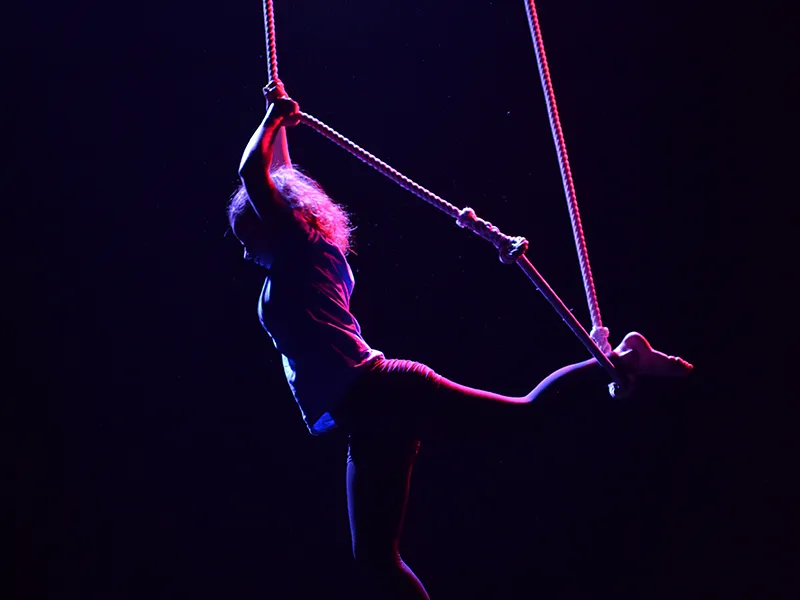
Ever feel as though your day is one big trapeze routine?
You launch from emails to errands, leap from “What are we having for dinner?” to “Did I remember that deadline?”, and let go of one meeting in mid air while hoping the next one catches you. By the time the day is over, you may have moved through work, family, messages, logistics, worries, decisions and the occasional search for your glasses while they are on your head. It can feel less like living and more like being flung from one thing to another with a diary in one hand and a snack in the other.
The strange thing is that most of us think the important part is holding on. We focus on the task in front of us, the next commitment, the next person who needs something, the next bar we need to catch. We often treat the space between one thing and the next as dead time. Just a blur between doing and more doing. Something to get through as quickly as possible.
But the in between moments may matter more than we think.
There is a small stretch of time after one task ends and before another begins. It might be the minute after a difficult call before you walk into the kitchen. It might be the journey home after work. It might be the few seconds between reading a frustrating email and replying to it. It might be the moment after you have finished supporting everyone else, just before you decide what you need.
Most of the time, we skip straight over that space. We finish one thing and immediately reach for the next. Another notification. Another question. Another responsibility. Another mental tab opens before the last one has properly closed. It is easy to see why. Life is busy, and slowing down can feel indulgent when there is always something waiting.
The Hidden Cost of Constant Task Switching
Yet our minds do not switch tasks as cleanly as our calendars suggest they should.
Research on task switching has repeatedly found that people tend to be slower and make more errors immediately after moving from one task to another. Psychologists call this a switch cost. Even when we know a change is coming and have time to prepare, some of that cost remains. Our brains have to disengage from the previous task, reset what they are focused on and bring the new task into view. That happens quickly, but it is not effortless.
This is worth remembering because modern life asks us to switch constantly. We move from work mode to parent mode, partner mode, carer mode, friend mode and back again. We go from a meeting about budgets to a text about someone’s health. We might leave a stressful conversation and immediately be expected to smile at a child, make dinner or answer a message as though nothing happened. The diary may say one thing has finished and another has begun, but the mind often carries some of the first thing into the next.
That does not mean we are bad at coping. It means we are human.
Why Transitions Matter
The problem is not that we have different roles. Most of us value the variety in our lives. The challenge comes when there is no room to land between them. When every transition is rushed, we can begin to feel as though we are never fully present anywhere. We are at home but still mentally in the meeting. We are speaking to someone we love but replaying an email. We are trying to rest while already preparing for tomorrow.
The result is often a low level sense of being scattered. Not necessarily overwhelmed enough to stop, but never settled enough to feel fully engaged either.
Learning to Let Go Before Moving On
This is where the trapeze metaphor becomes useful. A trapeze artist cannot hold every bar at the same time. At some point, they have to release one before catching the next. The moment in between can look risky, but it is also the moment where movement happens. Without letting go, there is no swing. Without space, there is no possibility of catching anything new.
Life works a little like that.
We cannot bring everything with us into every next moment. We cannot fully listen to someone while still fighting the last conversation in our head. We cannot properly rest while carrying every unfinished task as though it has just happened. We cannot be present in a new situation if we have not, even briefly, allowed ourselves to leave the old one.
Creating Better Transitions Throughout Your Day
The good news is that this does not require a major reinvention of your routine. You do not need to create a two hour transition ritual involving candles, ambient music and a handwritten letter to your nervous system. A pause can be very small. It may simply be enough to notice that one thing has ended before you begin another.
You might take one slower breath before opening the next email. You might sit in the car for sixty seconds before walking into the house. You might ask yourself, “What am I carrying from the last hour that does not need to come with me now?” You might take a brief walk around the block, make a drink without looking at your phone or write down the one thing still circling in your head so you do not have to keep holding it.
None of these actions is magic. They will not remove pressure, solve every difficult relationship or empty a demanding diary. But they can create a little separation between events. That separation can make it easier to respond rather than simply continue reacting.
What Research Says About Mental Recovery
There is useful research here on recovery too. Psychological detachment is the ability to mentally step back from work during non work time. It does not mean you never care about your job or cannot think about it at all. It means there are periods when your attention is not permanently tethered to demands, messages and unfinished tasks. Studies have linked the ability to detach with lower strain and better wellbeing, although it is important to say that switching off is not equally easy or equally beneficial for everyone in every circumstance.
The wider point is not that we should become perfectly calm people who glide from one part of life to another with the poise of a wellness advert. Most days will still involve mess, interruptions and the occasional emotional faceplant. The point is that transitions are not empty. They are places where we can restore a little control over how we arrive.
Showing Up More Intentionally
Think about the difference between walking straight from a tense meeting into a family meal, versus taking two minutes first to recognise that the meeting was tense. In the first version, the irritation may spill into the evening without anyone quite understanding why. In the second, you may still feel irritated, but you have named it. You have noticed it. You have a chance to decide whether it needs a conversation, a note for tomorrow or simply a little time to settle.
That tiny distinction can change the atmosphere around us.
It can also help with identity. Many people feel pulled between who they need to be in different parts of life. At work, you may need to be decisive, focused and responsible. At home, someone may need you to be patient, warm and available. With friends, you may want to be playful. Alone, you may simply want to stop being required to perform anything at all.
None of those versions of you is false. They are different parts of the same person. But moving between them can feel difficult when we do it at speed. A pause can help us choose how we want to show up next, rather than allowing the last role to dictate the next one.
That might sound like, “I have finished work, but I am not yet home in myself.”
Or, “I am leaving that conversation behind for now. I can return to it later if I need to.”
Or, “I am tired, and I do not need to pretend I have endless energy for the next thing.”
Or simply, “I am in between, and I get to choose how I arrive.”
This is not about becoming less productive. In fact, treating transitions with a little more care may help us become more deliberate. Task switching research suggests that preparation can reduce some of the immediate cost of changing activity, even if it cannot remove it completely. In ordinary life, that may mean taking a moment to decide what the next task actually requires before diving into it with half your attention still elsewhere.
Before a meeting, you might ask, “What do I need to focus on here?” Before going home, “How do I want the people I care about to experience me this evening?” Before replying to a difficult message, “What response would I still feel comfortable with tomorrow?” These are not grand questions. But they can stop us bringing unnecessary urgency, defensiveness or distraction into the next part of the day.
When the Problem Isn’t the Transition
There is a gentle warning in all this too. Sometimes the constant swinging is not just a matter of poor habits. It may be a sign that there is simply too much on the trapeze. Too many commitments, too little recovery, too many people needing something and too few moments where you are allowed to be unavailable. A pause cannot fix an unsustainable load. But it may help you notice that the load has become unsustainable in the first place.
That awareness matters. It may lead to a practical change. A clearer boundary. A conversation about support. A decision to stop saying yes quite so quickly. A recognition that rest is not a reward for finishing everything, because everything is unlikely to finish any time soon.
A Different Way to Move Through Your Day
It is easy to think the goal is to hold tight. To keep up. To catch every bar. To prove that we can manage every swing without missing a beat.
But perhaps the point of the trapeze is not simply to hold on.
Perhaps it is to fly.
That means allowing yourself a moment in the air. A breath between roles. A pause between demands. A chance to let go of what has ended before deciding how to meet what comes next.
Myles can be part of that pause. Not as another task on the list, and not as a voice telling you to optimise every second of your day. More as a small space to check in, notice what you are carrying and decide what you want to bring into the next moment.
So this weekend, as you swing between “I should be productive” and “I desperately need a nap”, perhaps allow yourself a little hang time.
Wiggle your toes.
Wave at the crowd.
Then catch the next bar when you are ready.
One step at a time.